

Private beta
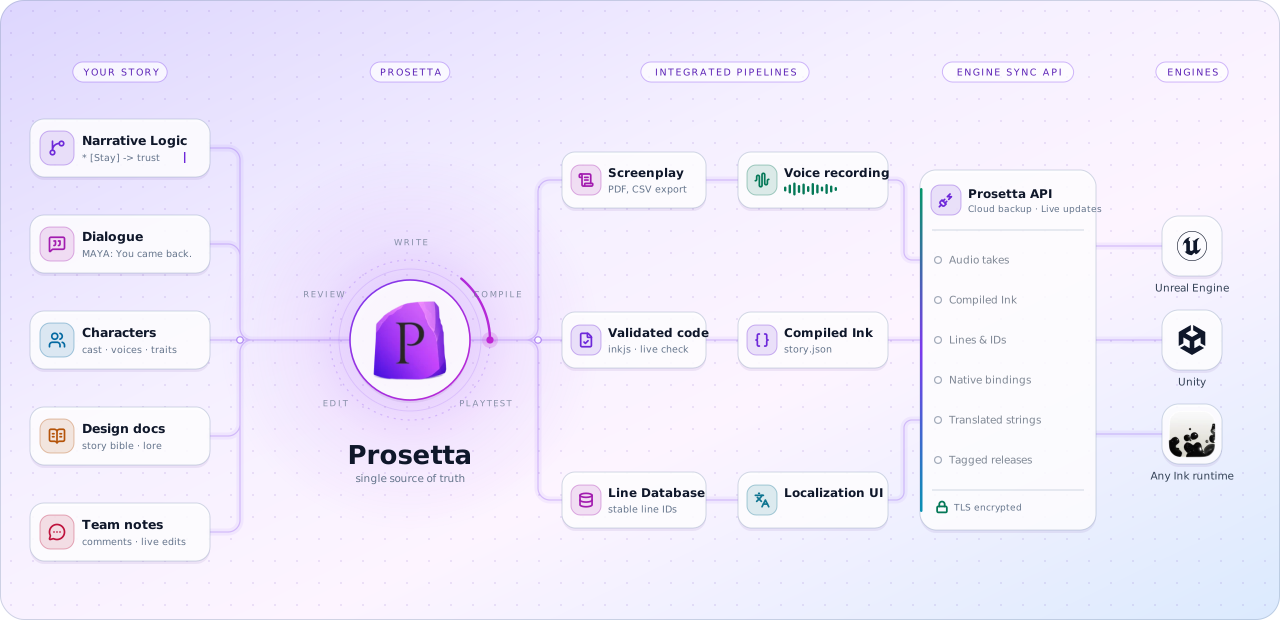
Your game’s story is scattered across five tools and a spreadsheet. Prosetta replaces all six.
One live workspace where your team writes, reviews, voices, translates, and playtests together, synced straight into your engine.
01Live collaboration
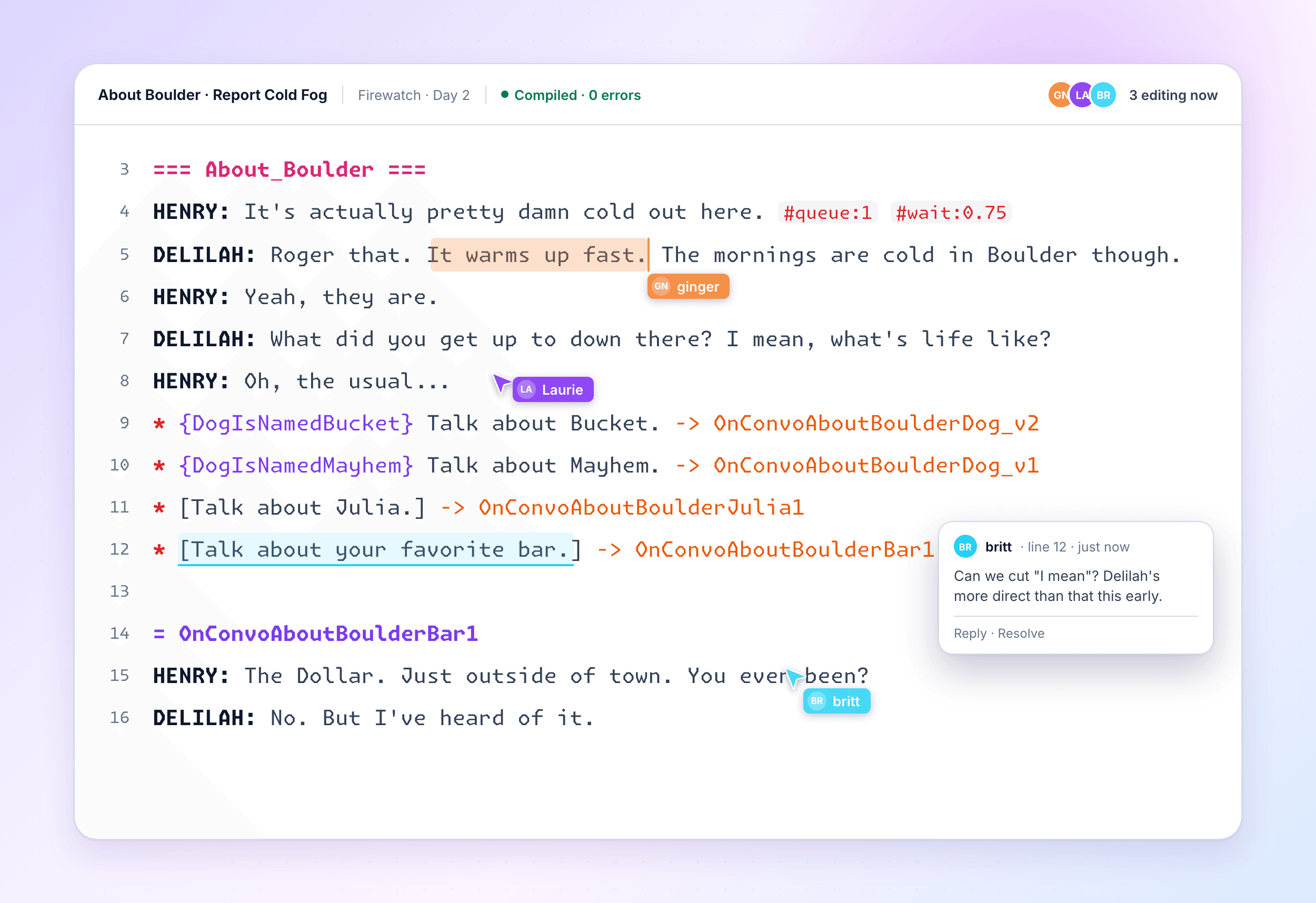
Write together. Actually together.
The script is always live, and it’s the hub for the whole team. See who’s working where, review and approve lines in comment threads right beside them, and never merge a file again.
02Flow view and Ink Player
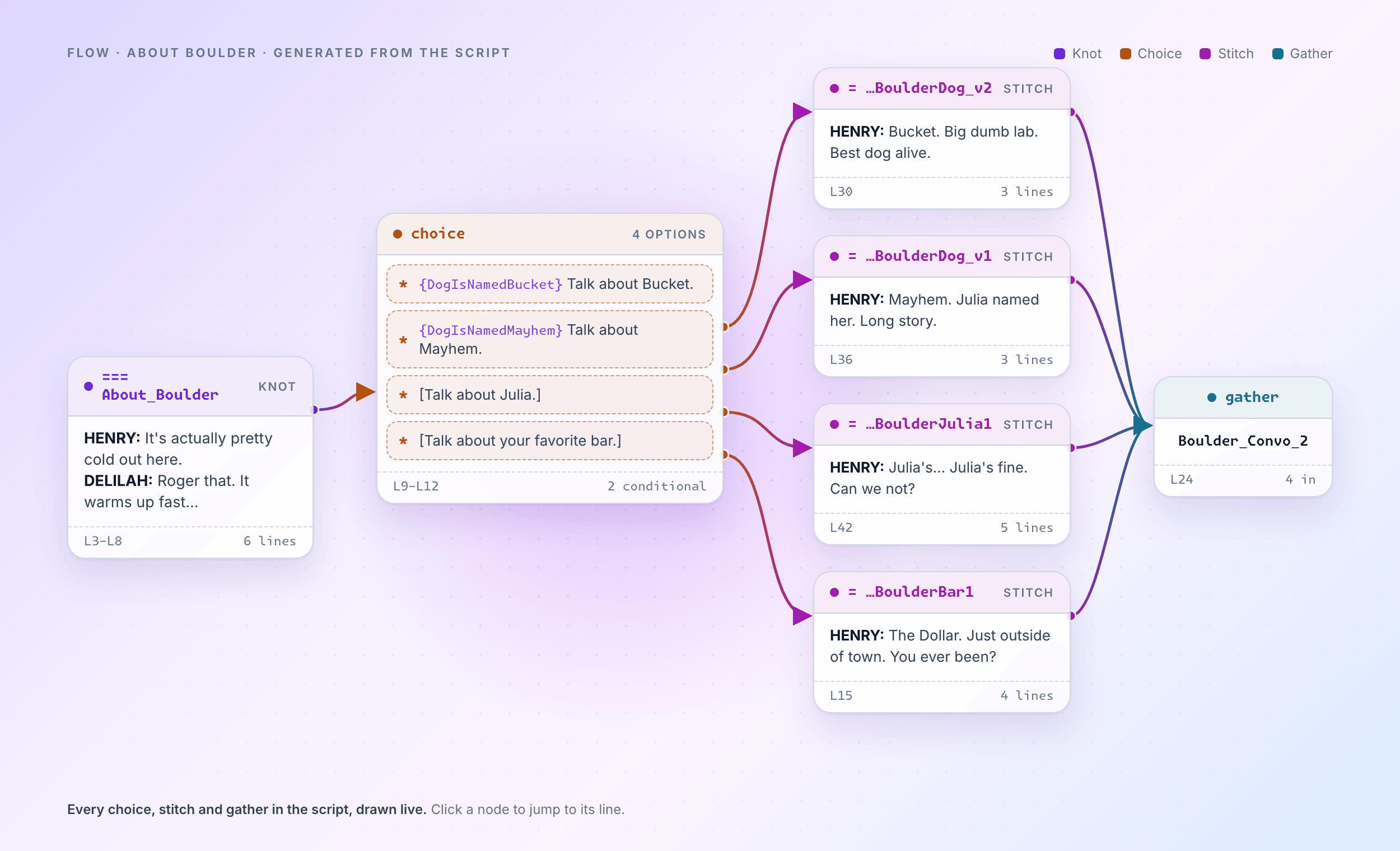
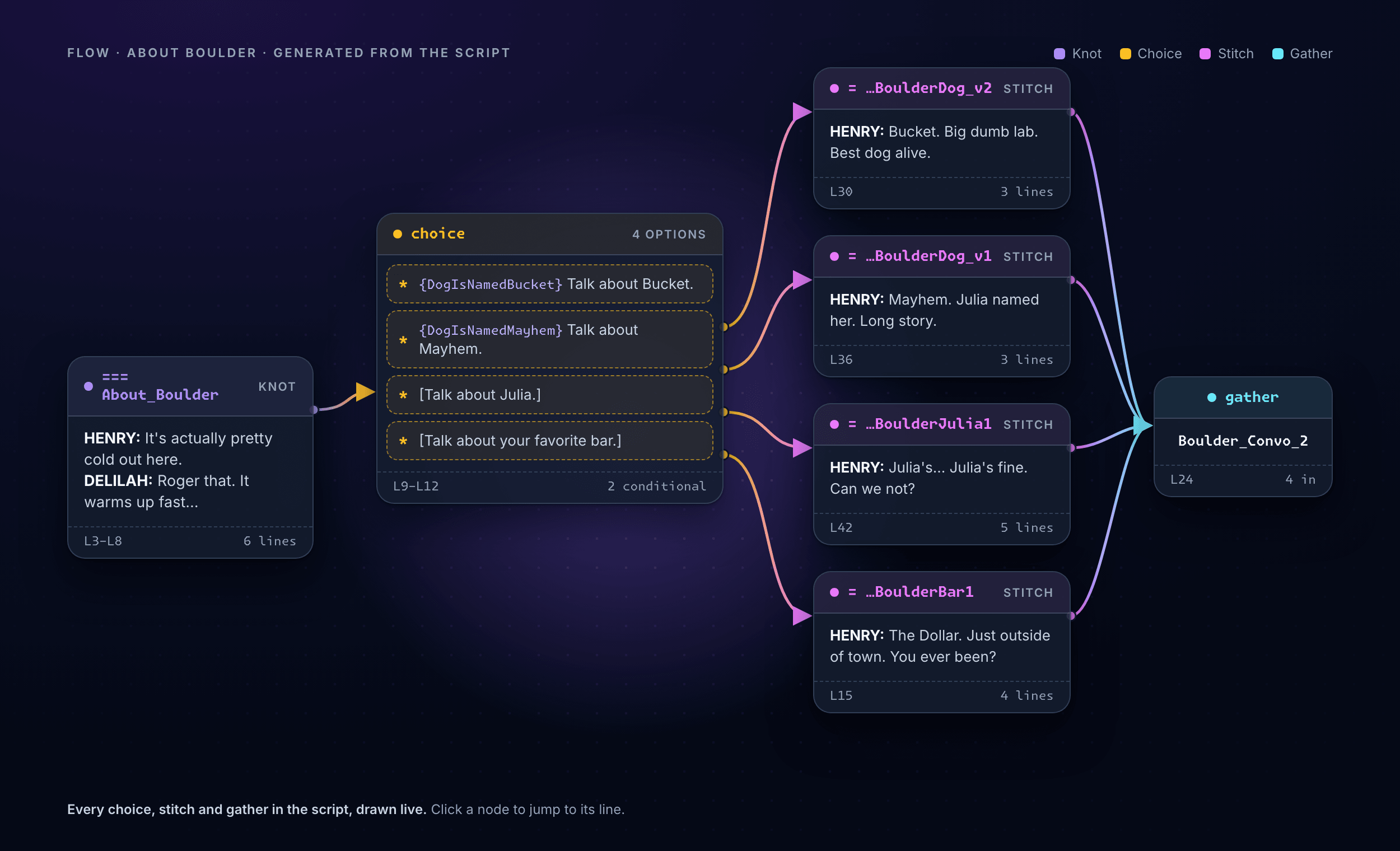
See every path. Then play it.
Flow draws every scene, choice, and branch live from the script, including the ones no player can reach. The Ink Player runs the real game logic and save data right beside the editor, while your team keeps writing.
03Voiceover
Voice your game as you write it. No waiting, no wiring.
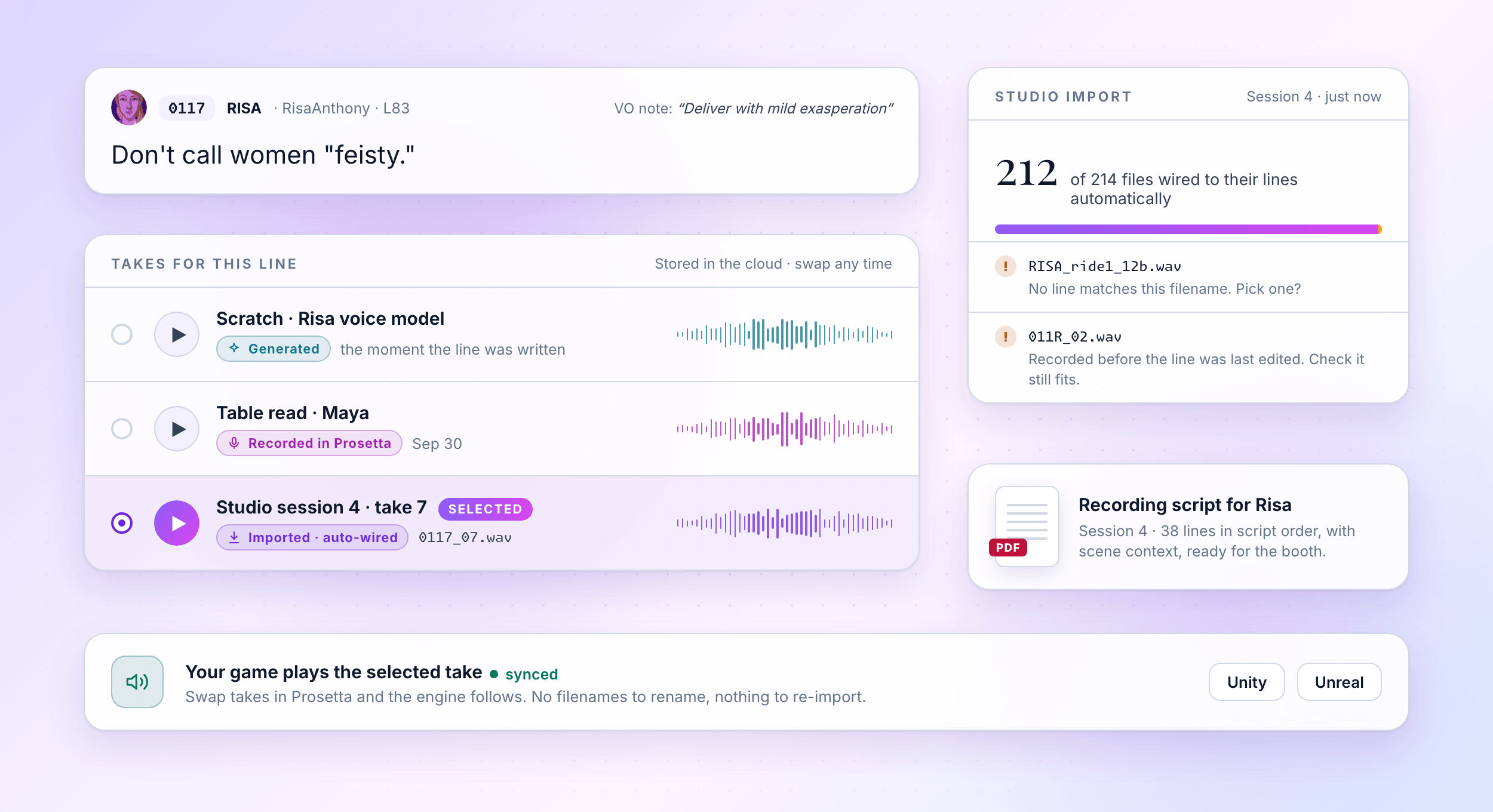
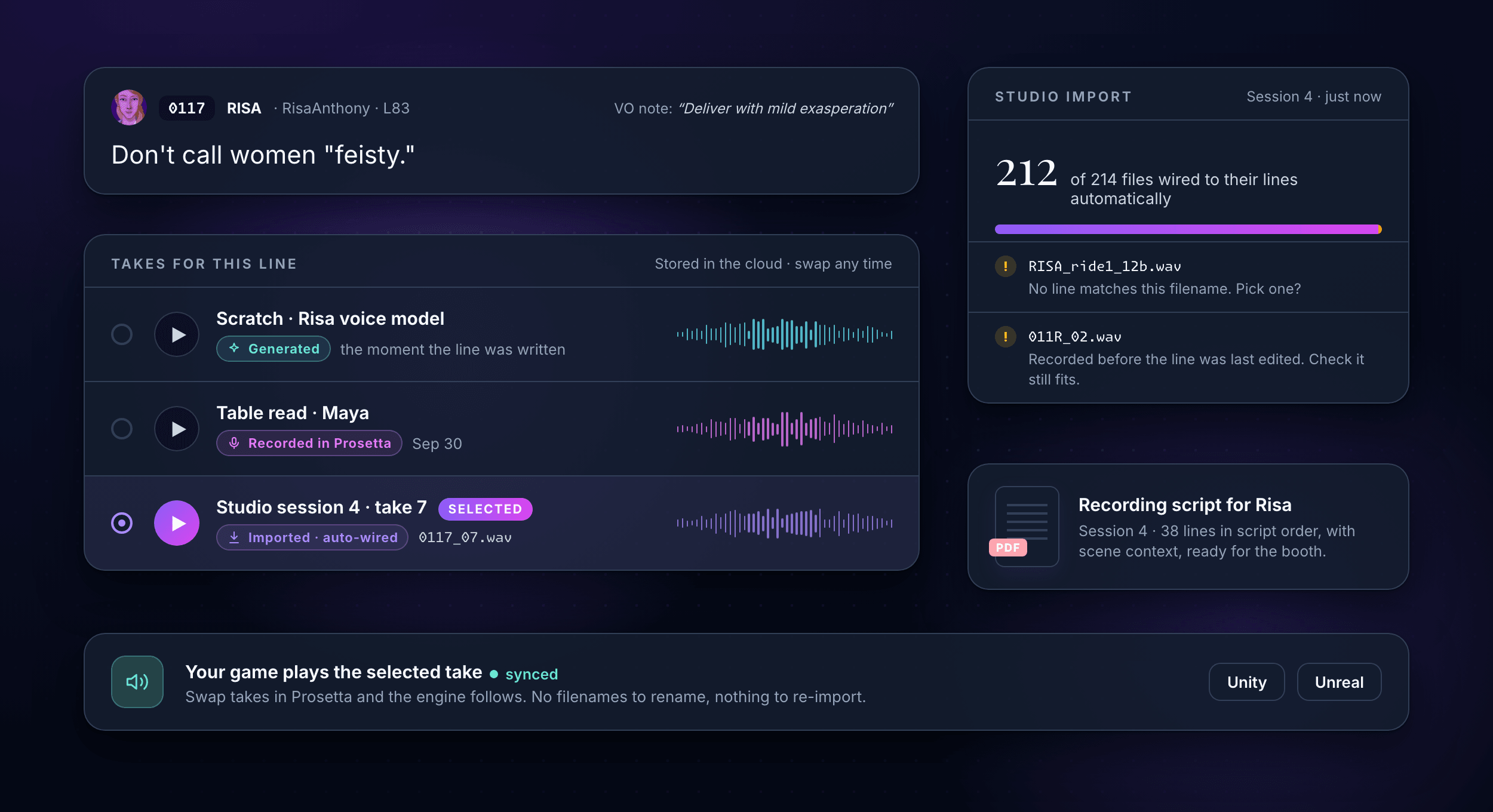
Scratch vocals generate from custom voice models as lines are written. Real takes, recorded in Prosetta or imported from the studio, wire themselves to their lines, and your engine always plays the one you’ve selected.
Everything in voiceover
- Scratch vocals generated automatically, with the latest custom voice models
- Record takes straight into Prosetta
- Every take kept in the cloud; swap the selected one and the engine follows
- Recording scripts for actors, exported as PDF
- Bulk import of studio audio, wired to lines automatically
- Import checks that flag files with no matching line, or lines edited since recording
04Localization
Translate the game, not a spreadsheet.
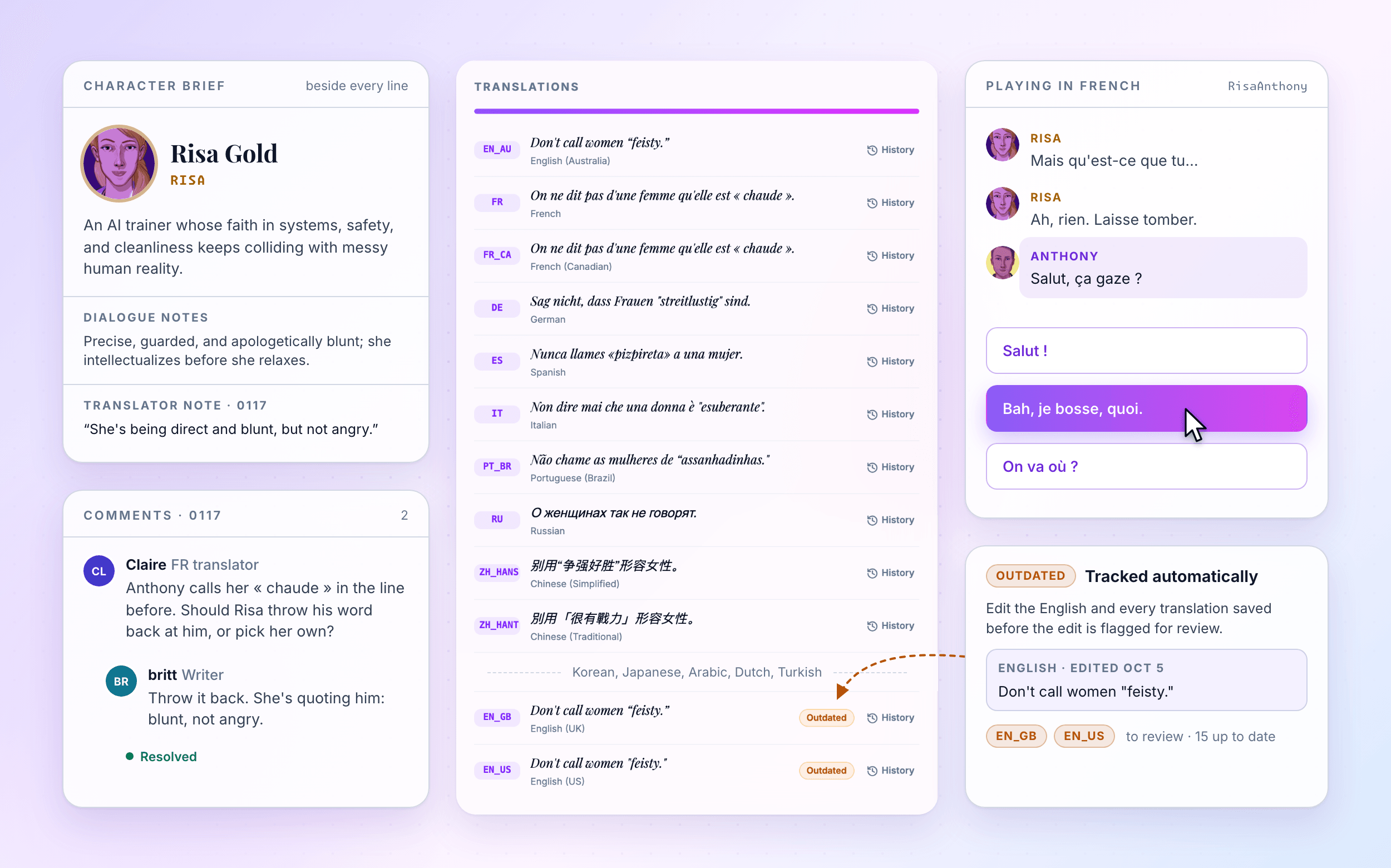
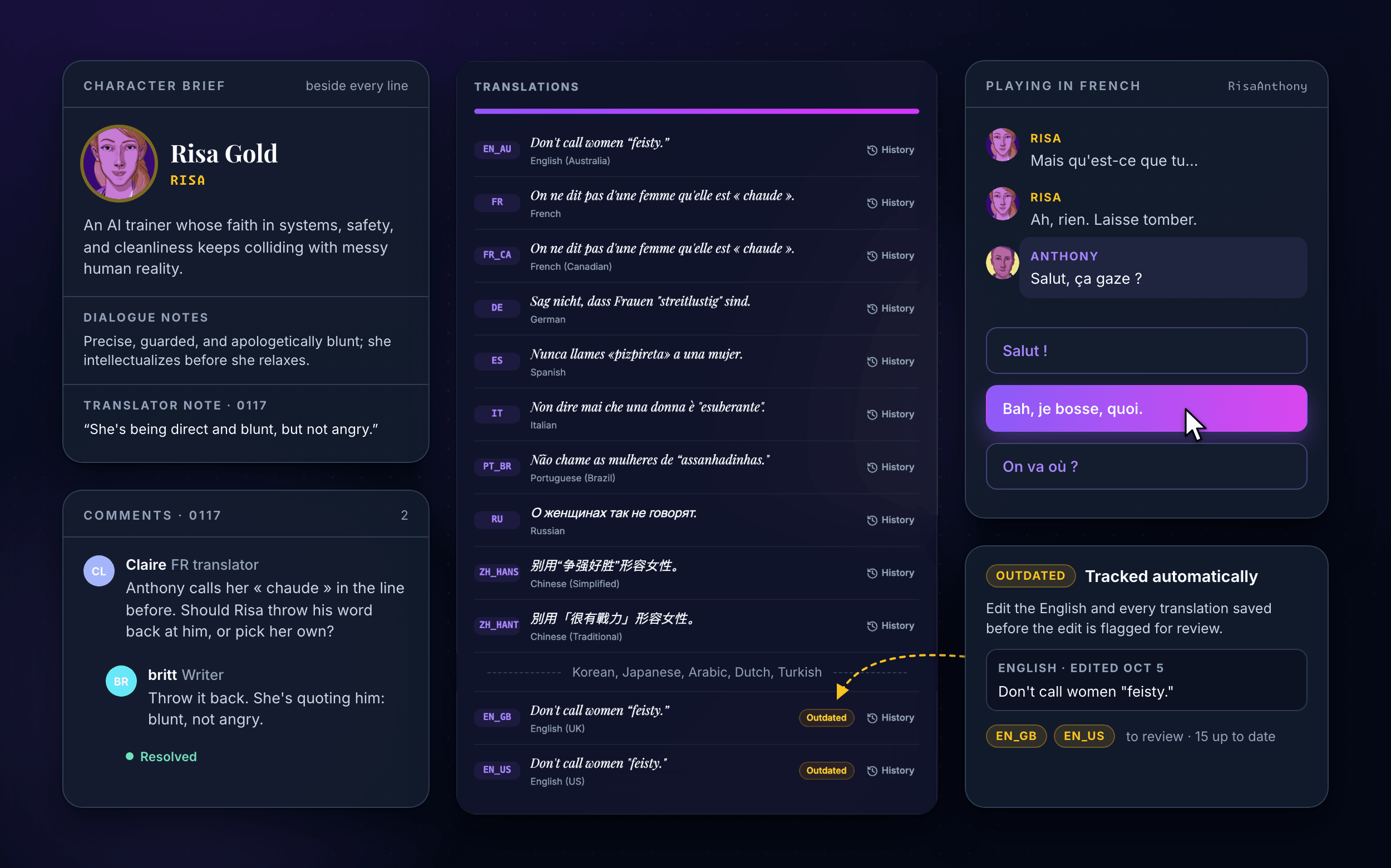
Translators work in the same live workspace the writers do, with the scene playable in their language, the character brief beside every line, and the writers a comment away.
Everything in localization
- Translators work in the same editor the writers use
- Play through the live game, with its real logic and data, in any language
- Character briefs and story docs beside every line
- Comment threads with the writers, right on the line
- A lines table with fuzzy search and filters
- Change tracking flags every translation a source edit affects
- AI first drafts that translators review and refine
05Line history
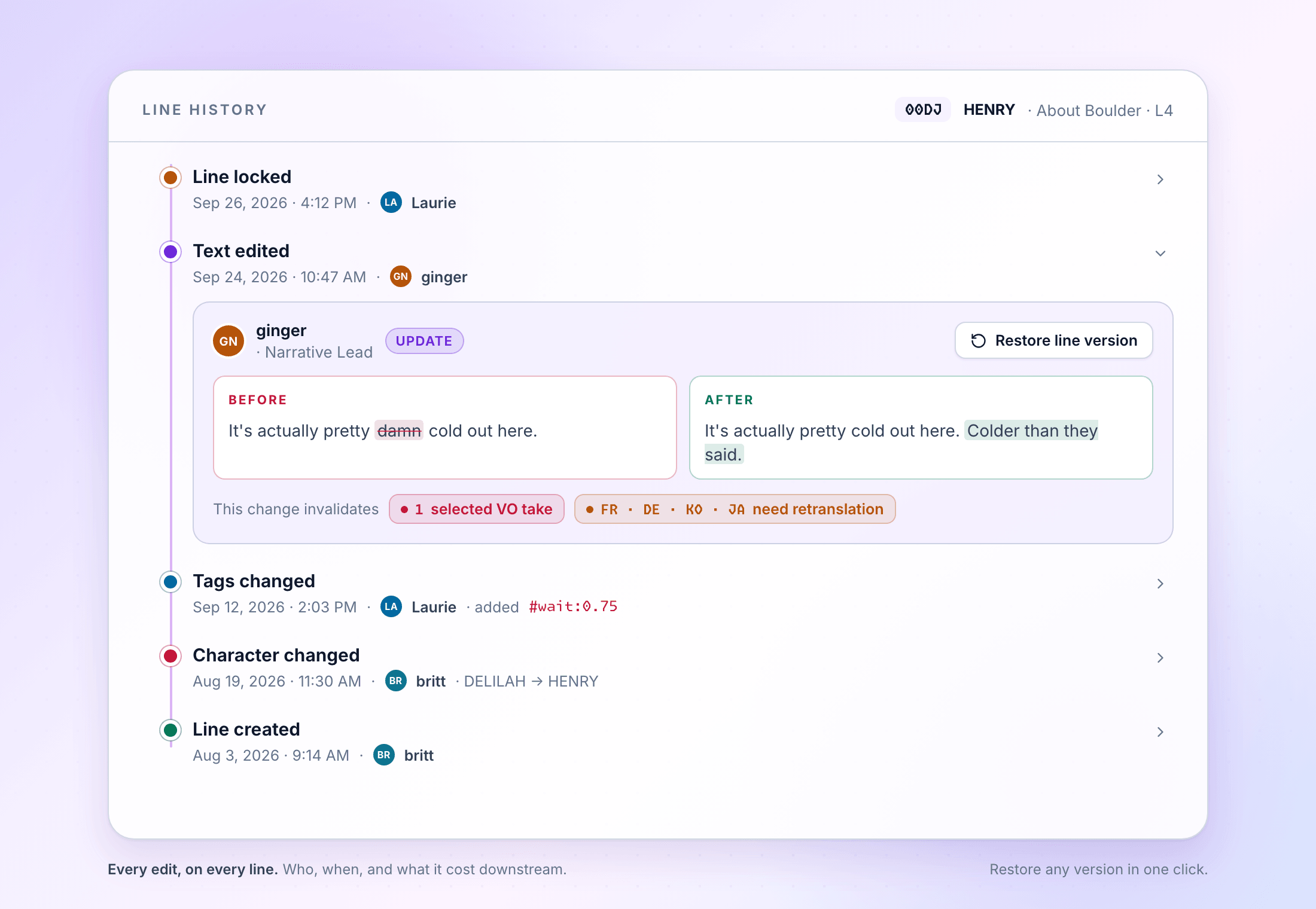
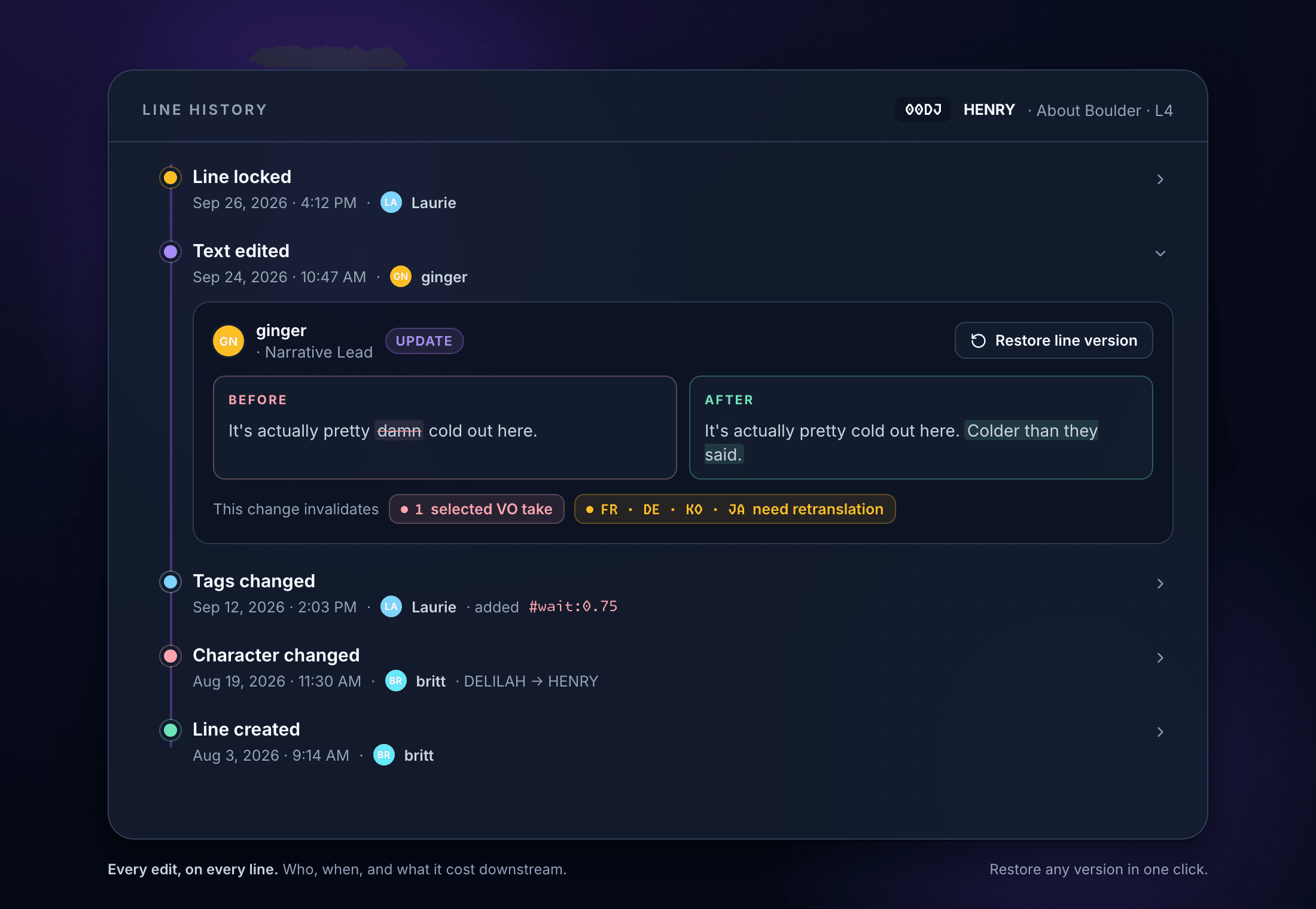
Rewrite late. Re-record only what changed.
Every edit shows who made it, when, and exactly which voice takes and translations it made stale. Late changes become a short list, not a guessing game.
06Review and sign-off
“Is this line final?” Now everyone knows.
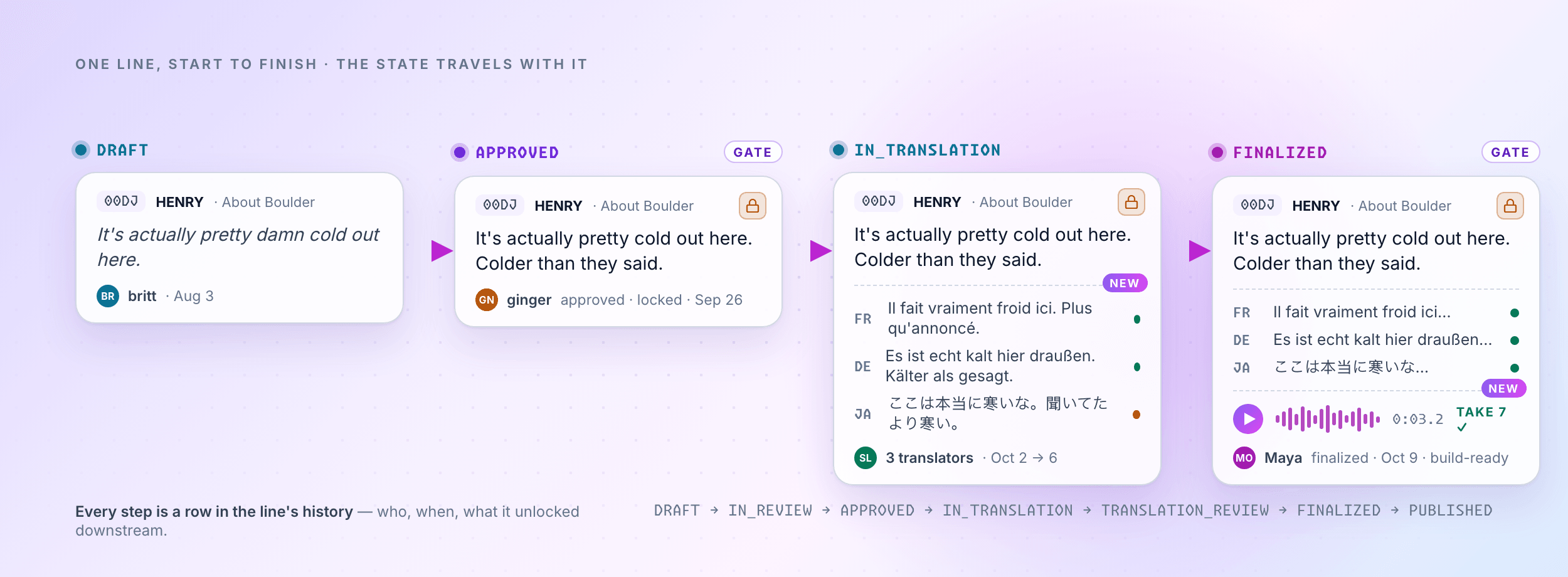
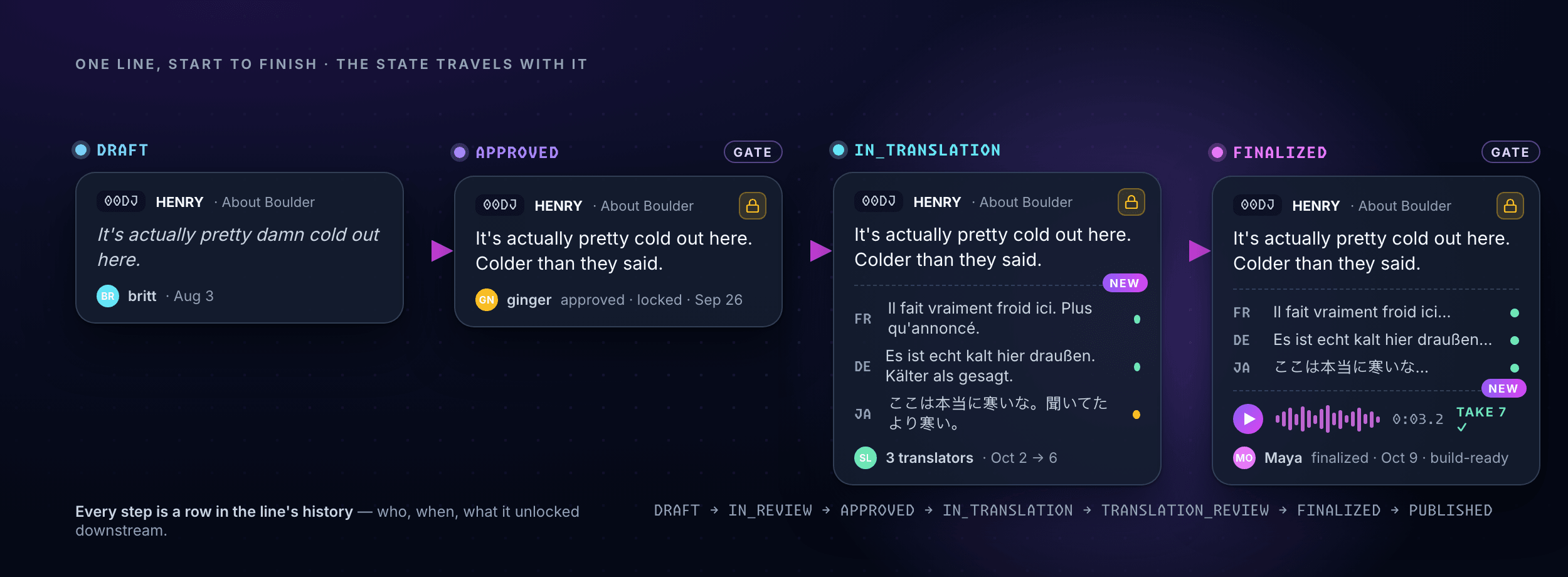
Each line moves from draft to approved to translated to recorded, with sign-off gates along the way. Status lives on the line, not in a spreadsheet someone forgot to update.
07Roles
Bring in the whole team.
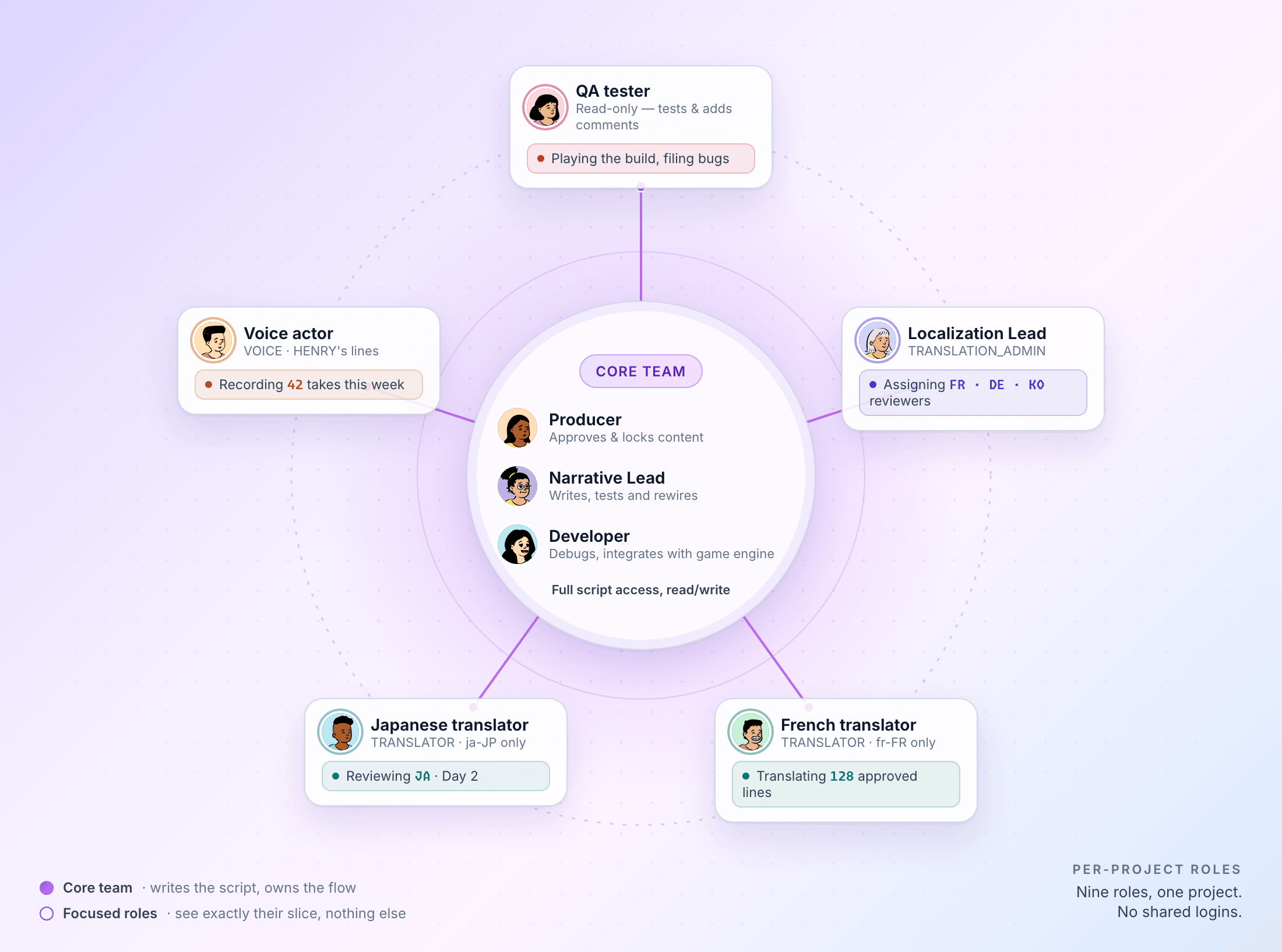
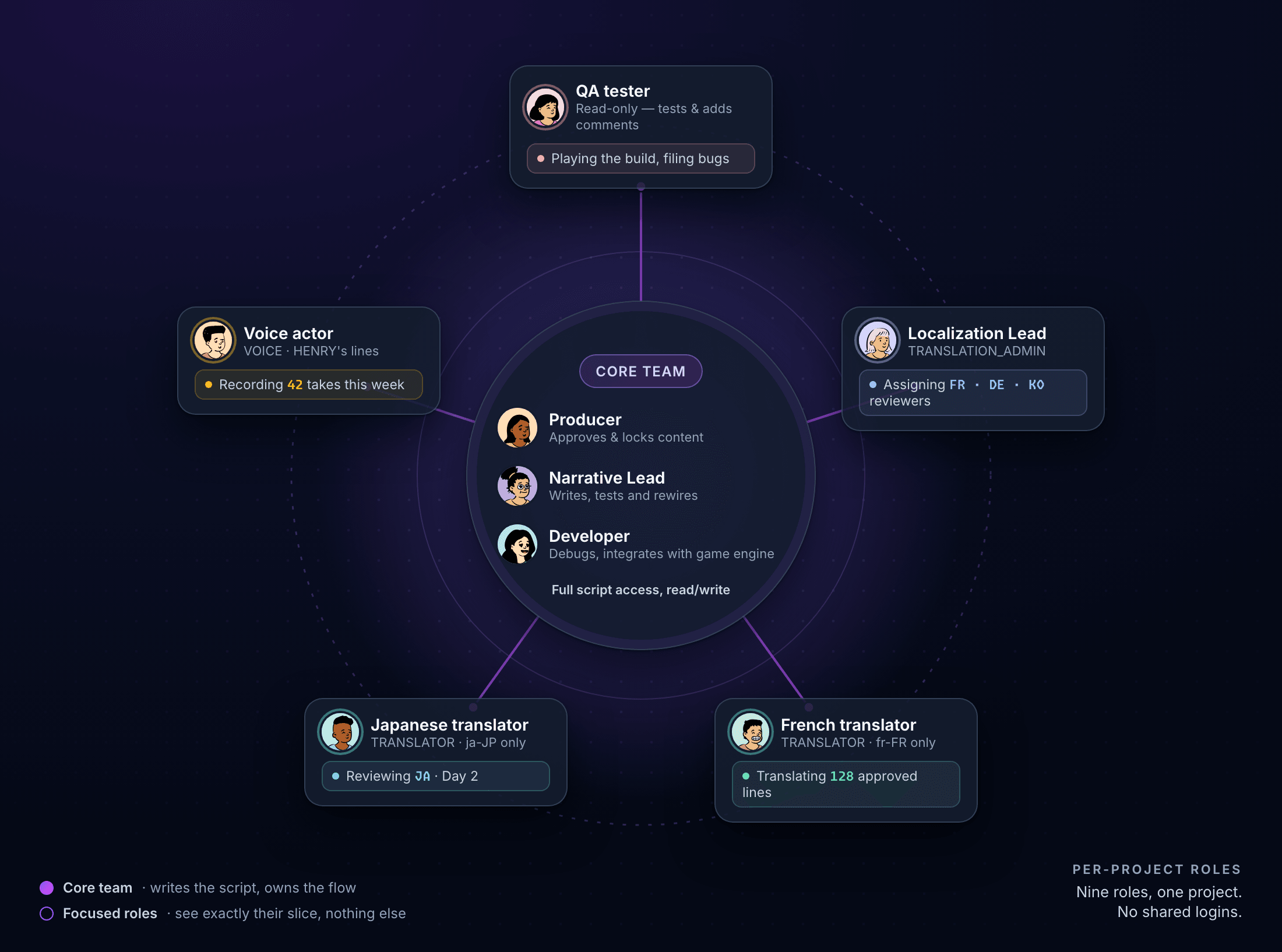
Translators, actors, QA, and engineers each get exactly the slice of the project their job needs, so everyone can contribute without touching what isn’t theirs.
08Engine sync
No more export, import, repeat.
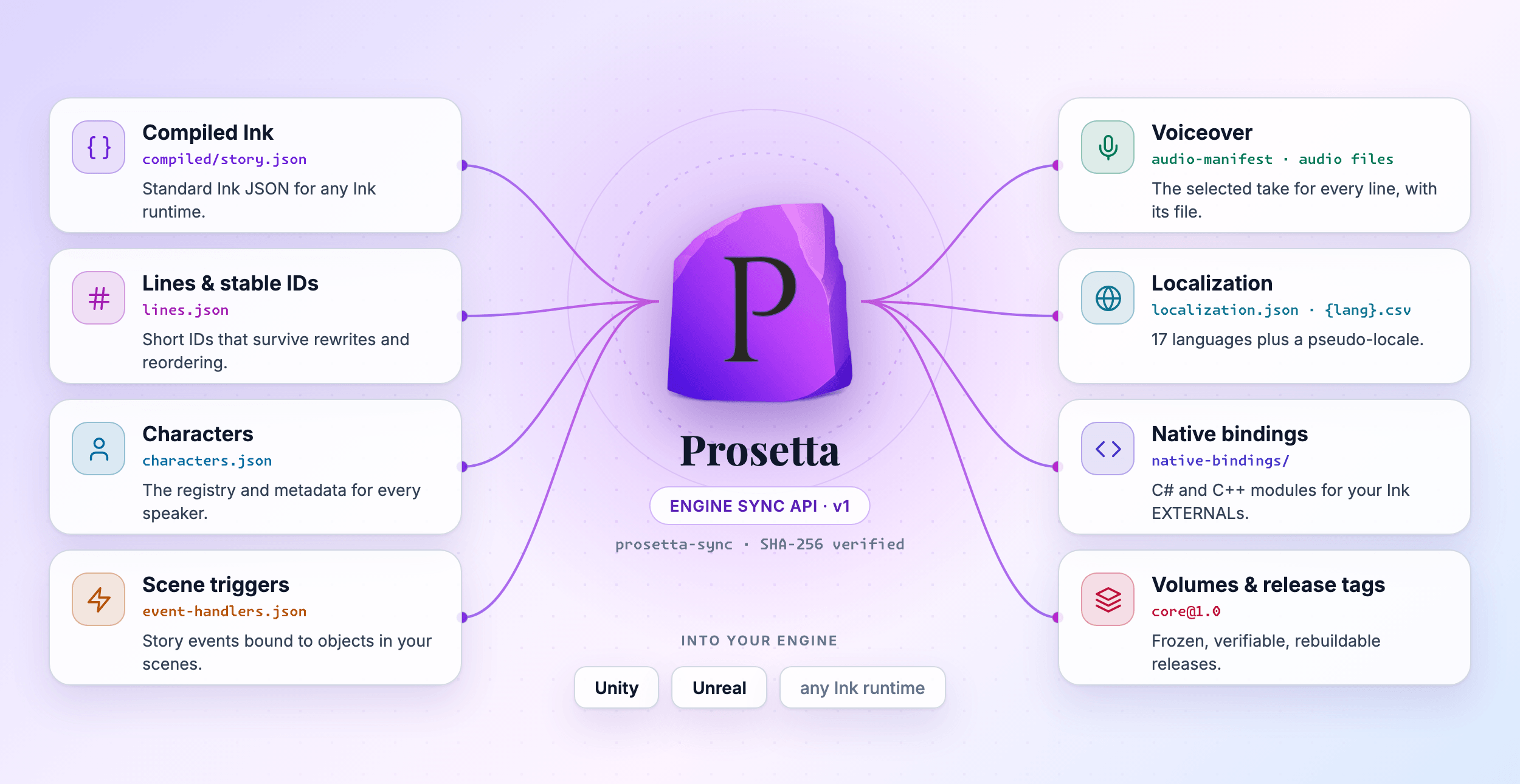
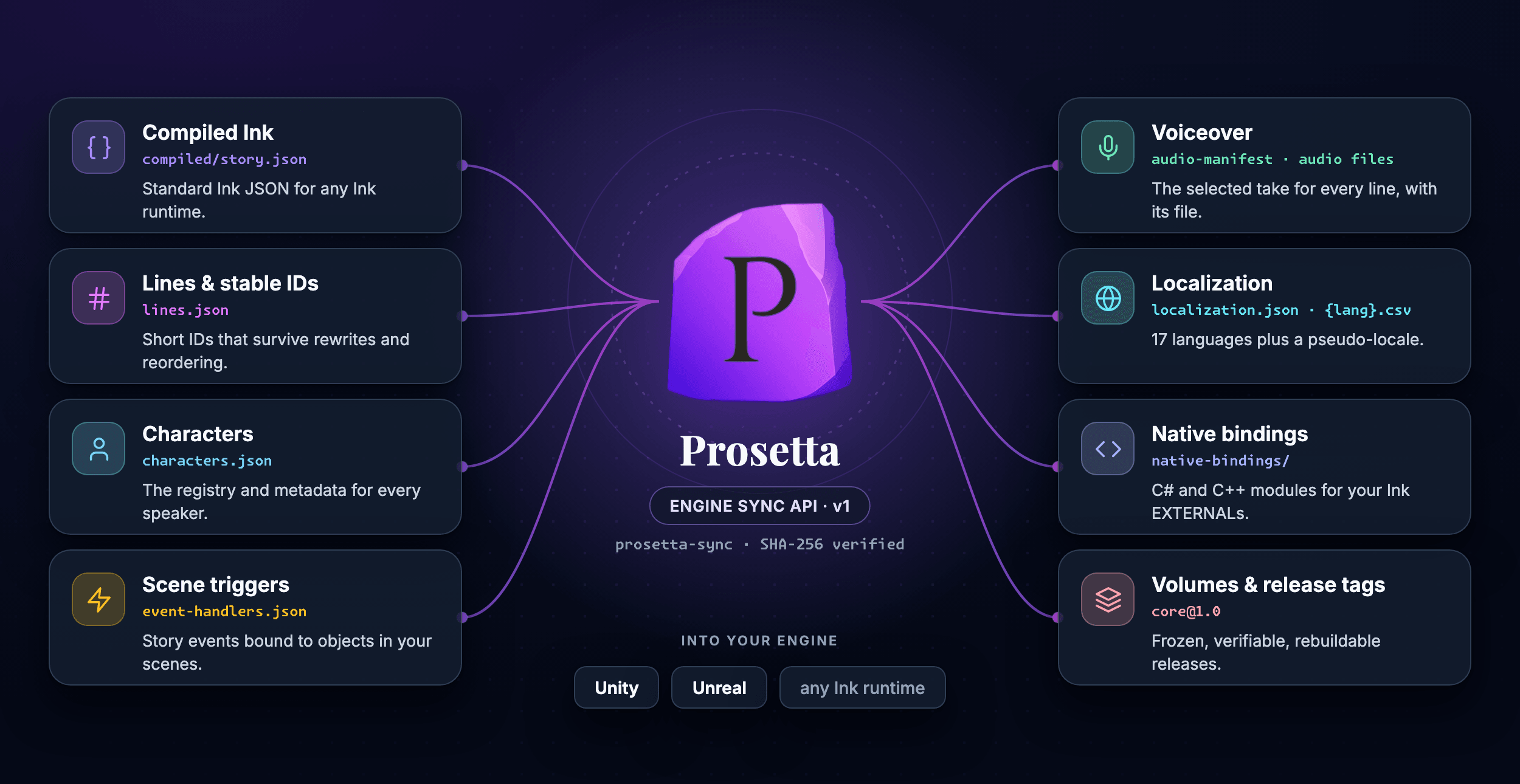
Your game pulls the story, voiceover, and translations straight from Prosetta into Unity or Unreal. Pin a build to a tagged release and only a script that compiled cleanly gets in.
What goes away
Not just a faster pipeline. Less pipeline.
When the script, the voice, the translations, and the build all live in one place and update together, whole categories of busywork simply stop existing.
- Without Prosetta: Merging script files and asking “which draft is the latest?”With Prosetta: One live script, with the whole team in it at once.
- Without Prosetta: Playing for an hour to find the branch that never firesWith Prosetta: Every path drawn live, unreachable ones included.
- Without Prosetta: Waiting for a build to play how a rewrite turned outWith Prosetta: Play the live script, with real game logic, as it changes.
- Without Prosetta: Renaming and re-importing hundreds of audio files after every sessionWith Prosetta: Studio takes wire themselves to their lines.
- Without Prosetta: Emailing translators a spreadsheet with no contextWith Prosetta: Translators work in the live game, with briefs and the writers on hand.
- Without Prosetta: Re-recording a whole scene because nobody knows what changedWith Prosetta: Each edit lists exactly which takes and translations it made stale.
- Without Prosetta: Status meetings and Slack threads to find out what’s approvedWith Prosetta: Every line shows its status, with sign-off built in.
- Without Prosetta: A writer’s typo breaking tonight’s buildWith Prosetta: Errors flagged as you type. Your game pulls only clean, tagged releases.
Thirty minutes. Bring your gnarliest pipeline problem.



Hi, I’m Phenry. Before creating Prosetta, I built Magpie, the dialogue, voiceover and localization tool behind Firewatch. On Neo Cab I was creative director and built the game’s Ink pipeline. At Netflix I worked on Branch Manager, its in-house tool for narrative games. Prosetta is the tool I always wished I’d had. We’re currently taking on Design Partners: medium to large, established game studios working on ambitious early-stage projects. Let’s see if Prosetta fits your team.